Blog
Corporate Giveaways: Complete Guide to Branded Merchandise

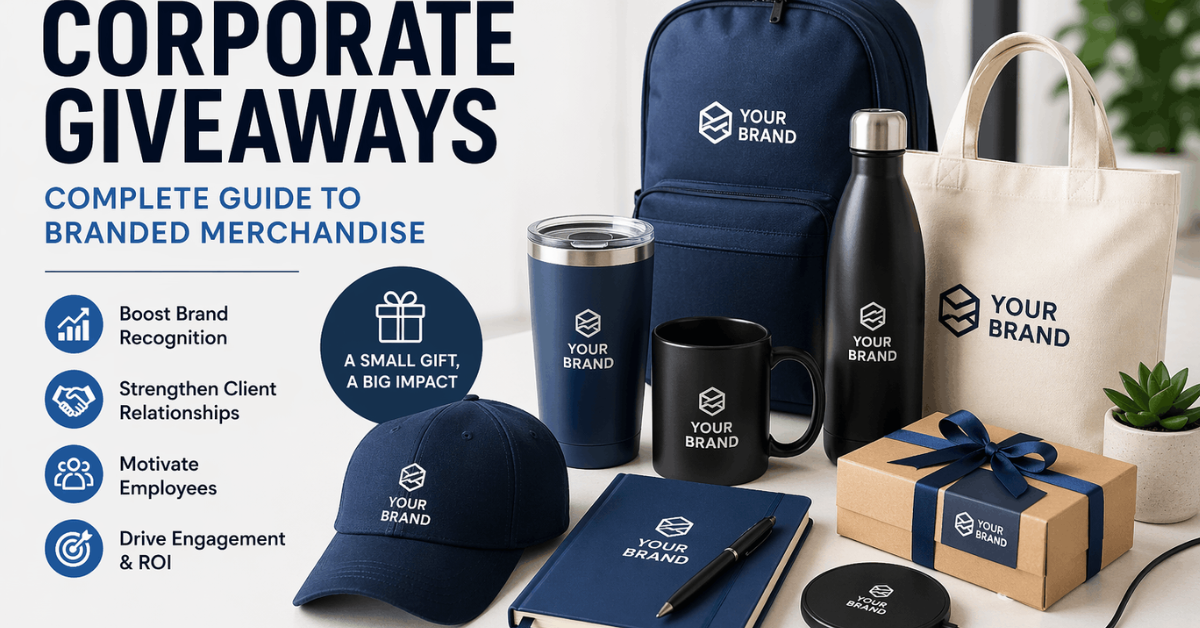
Done right, corporate giveaways are one of the highest-ROI brand touchpoints a business can invest in — turning a simple gift into a lasting brand impression, a stronger partnership, or a closed deal.
What Are Corporate Giveaways?
Corporate giveaways are branded or unbranded products that businesses distribute to clients, employees, prospects, or event attendees as a gesture of appreciation, promotion, or relationship-building. Unlike traditional advertising, a well-chosen giveaway creates a tangible, physical connection between your brand and the recipient — one they can see, use, and remember long after the first interaction.
You may encounter this category under several related terms: promotional products, branded corporate gifts, swag, business gifts, or corporate gifts. At the same time, there are subtle distinctions — corporate gifts tend to be higher-value items sent to individuals, while giveaways are often distributed more broadly — they all share the same strategic purpose: keeping your brand top-of-mind.
Why Corporate Giveaways Matter for Brand Growth
Physical branded items outperform digital ads in one critical dimension: persistence. A well-designed tote bag or quality pen doesn’t disappear after three seconds of screen time — it sits on a desk, travels on a commute, and surfaces at a meeting. Every use is a free brand impression.
82% of consumers have a more favorable opinion of a brand after receiving a promo item
7yr average lifespan of a quality branded item before disposal
~$0.004 average cost-per-impression for promotional products vs. $0.033 for TV
The strategic value of corporate giveaways spans both internal and external goals. Externally, they are among the most effective customer engagement ideas available — strengthening client relationships, accelerating the sales cycle, and driving meaningful interaction at every event touchpoint. Internally, they boost employee morale, reinforce company culture, and serve as meaningful recognition during onboarding or milestones.
Types of Corporate Giveaways
The corporate giveaway landscape is broad. Understanding the major categories helps you match the right item to the right audience and occasion.
- Office & Desk Items
Notebooks, pens, calendars, mousepads. Daily-use items with high visibility.
- Apparel & Wearables
T-shirts, hoodies, caps, tote bags. High social impressions per item.
- Tech Accessories
USB drives, wireless chargers, earbuds. Premium perception at scale.
- Drinkware
Branded mugs, tumblers, water bottles. Highest average daily use rate.
- Eco-Friendly Items
Bamboo products, seed kits, recycled bags. Aligns with sustainability values.
- Premium Gift Sets
Curated kits for VIP clients or C-suite. High-touch relationship building.
Event giveaways vs. client gifts
At trade shows or conferences, the goal is reach — lighter, cost-effective items like lanyards, branded pens, or reusable bags work best. For one-to-one client gifting, invest more heavily: a custom gift box with handwritten messaging, a premium journal, or a curated wellness kit signals genuine appreciation and strengthens long-term relationships.
How to Choose the Right Corporate Giveaway
Effective corporate giveaways start with knowing your audience and your goal. Here’s a practical framework used by professional procurement teams:
- Define the purpose. Is this a trade show giveaway, an employee milestone gift, a client thank-you, or a product launch promotion? Each calls for a different item and budget range.
- Know your recipient. A tech-savvy remote team values wireless accessories. A wellness-focused client appreciates an organic tea set. Generic gifts are forgettable; relevant gifts are remembered.
- Respect the budget intelligently. A $5–$15 per-item budget is appropriate for broad event distribution. A $50–$150 budget makes sense for key clients or top-performing employees.
- Prioritize utility and quality. Items that are used daily generate far more brand impressions than items that end up in a drawer. A high-quality stainless tumbler beats a cheap stress ball every time.
- Add personalization where possible. Even a logo placement choice or a custom color can significantly elevate perceived value.
- Check compliance and cultural considerations. Some industries have gift value limits (financial services, government). When gifting internationally, research local gift-giving customs.
Trends Shaping Corporate Giveaways in 2026
The promotional products industry continues to evolve rapidly. Here are the most significant trends influencing corporate giveaway procurement decisions this year:
Sustainability as a baseline expectation
Eco-friendly options are no longer a niche request — they’re increasingly the default expectation, especially from environmentally conscious clients and younger employee demographics. Recycled materials, plantable paper products, and carbon-offset shipping are now standard conversations with most reputable suppliers.
Experiential and digital hybrid gifting
Brands are pairing physical items with digital experiences: a beautifully packaged notebook that comes with access to an online productivity course, or a premium coffee set bundled with a virtual tasting event. This hybrid approach creates a richer, more memorable gifting journey.
On-demand and print-on-demand models
Rather than maintaining large inventory, many companies are shifting to on-demand branded merchandise platforms. These allow employees or clients to choose their own items from a curated branded storefront, reducing waste and increasing satisfaction.
Wellness and self-care items
Post-pandemic shifts in workplace values have elevated wellness-related items. Branded yoga mats, aromatherapy kits, ergonomic desk tools, and mindfulness journals have all seen strong uptake — and for companies treating gifting as part of their broader business growth strategies, these high-perceived-value items consistently deliver the strongest retention and referral outcomes.
Frequently asked questions
What is an appropriate budget for corporate giveaways?
For broad event distribution, $5–$20 per item is standard. For individual client gifts or executive-level recipients, $50–$200 is typical. Employee milestone gifts (work anniversaries, promotions) often range from $30–$100 depending on company culture and seniority level.
Are corporate giveaways tax-deductible?
In many jurisdictions, corporate gifts and promotional items are partially or fully tax-deductible as a business expense. In the United States, the IRS currently allows a deduction of up to $25 per client gift per year. Always consult your accountant or tax advisor to confirm the rules applicable in your region.
What are the most popular corporate giveaway items?
Consistently top-performing categories include branded drinkware (insulated tumblers, mugs), apparel (branded T-shirts, hats), tech accessories (wireless chargers, earbuds), and quality notebooks. The most effective items tend to be those recipients actually use daily — utility drives impressions.
Corporate giveaways are far more than branded trinkets — they’re a proven, cost-effective channel for building brand recognition, deepening client relationships, and strengthening company culture. The key is intentionality: choose items that align with your brand values, serve your recipient’s daily life, and reflect the quality your business stands for. Whether you’re planning for a major trade show, an employee appreciation campaign, or a personalized client gifting program, partnering with a trusted provider like Pragmatic Corporate Gifts can elevate your approach and ensure every giveaway feels purposeful. A thoughtful strategy turns a simple giveaway into a lasting brand asset.